AI as a Service UK: What It Is, What to Ask, and What It Costs
By Ashish Kapur
122 Views
AI as a Service (AIaaS) for UK Businesses: A Practical 2026 Guide
There's a category of vendor that describes their offering as "AI as a service" and means something slightly different every time. Some mean API access to a large language model. Some mean a managed platform where they run your AI workloads. Some mean a consultant who will "implement AI" in your business and call it a service. The category is real, but the terminology is loose enough to create serious confusion at the contract stage.
This guide is written for UK businesses trying to understand what they're actually buying — what AI as a service UK providers offer, what compliance requirements apply specifically in the UK in 2026, what it costs, and what to watch for when evaluating providers.
What AI as a service actually means
At its core, AI as a service (AIaaS) means accessing AI capabilities through a vendor's infrastructure rather than building and maintaining them yourself. The vendor trains and hosts the models, manages the computing infrastructure, and handles updates. You access the capabilities via API or a managed interface and pay based on usage or a subscription.
The appeal is straightforward: you get AI without needing a data science team, GPU servers, or the years of data engineering that training useful models requires. The risks are also straightforward: you become dependent on a vendor, your data may leave your systems, and you're subject to pricing changes you can't control.
Neither of these is a reason to avoid AIaaS. They're reasons to go in with clear eyes.
The four types of AIaaS: which one your business probably needs
The term covers four meaningfully different things:
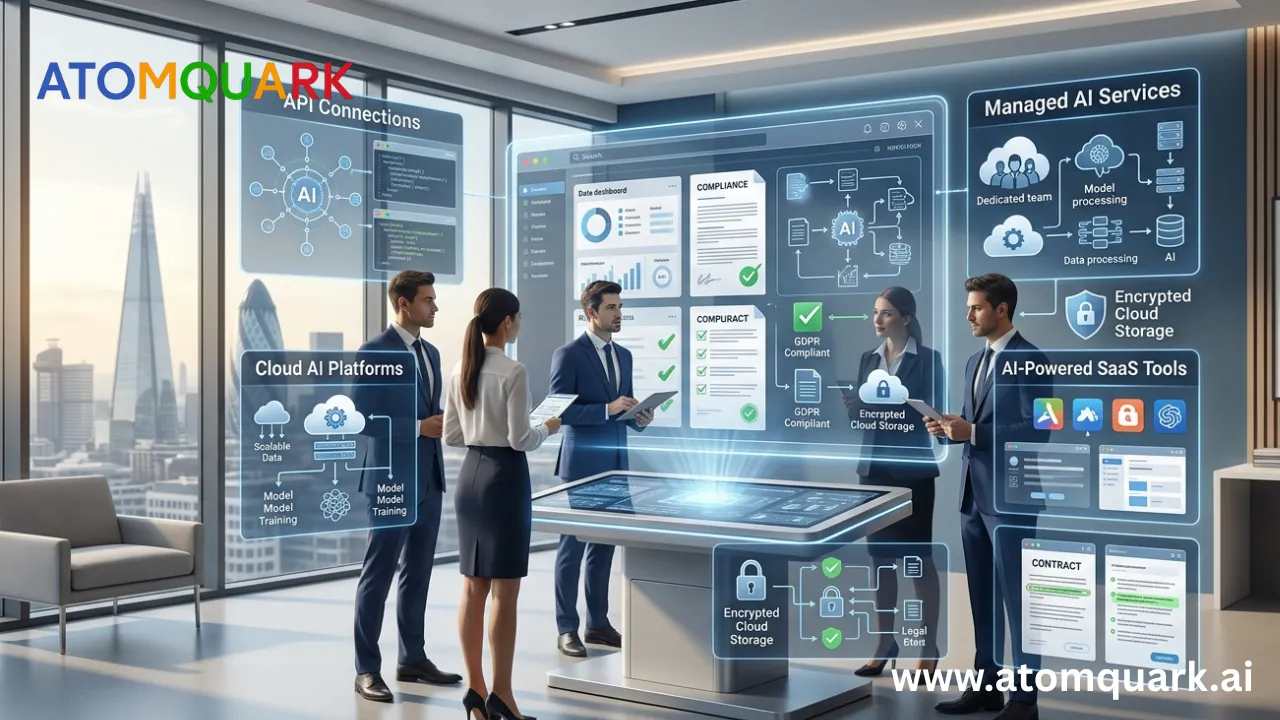
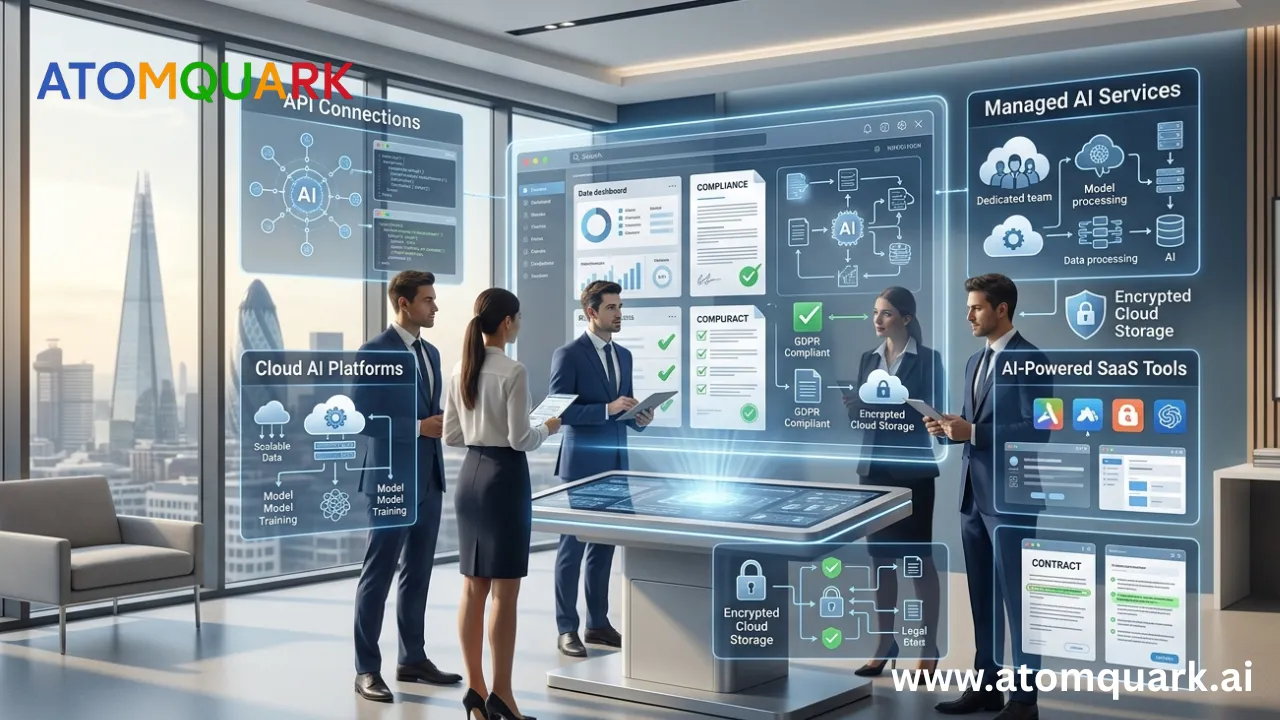
API-based AI (pay-per-use): You send data to a provider's model via API and get a result back. OpenAI, Google Cloud AI, and Azure AI work this way for most features. You pay per token, per image processed, per prediction. This is the simplest entry point and the right choice for adding AI capabilities to existing software without building anything from scratch.
AI platforms (managed infrastructure): A provider gives you tools to deploy and run AI models (your own or pre-built) without managing the underlying servers. AWS SageMaker, Google Vertex AI, and Azure ML fall here. Better suited to companies that need to run proprietary models or have specific infrastructure requirements.
Managed AI services (full outsourcing): A provider handles everything: selecting the right models for your use case, integrating them with your systems, monitoring performance, and maintaining them over time. This is what specialist UK AI services companies offer, and what most SMBs actually need when they say they want "AI as a service."
AI-embedded software (AIaaS in disguise): Your CRM now has AI-powered lead scoring. Your accounting software predicts cash flow. Your helpdesk auto-classifies tickets. This is AIaaS built into a product you're already buying. It's worth recognising because the compliance questions still apply: the AI provider powering those features may be processing your data in ways your SaaS vendor hasn't clearly disclosed.
Most UK businesses asking about AI as a service actually need the third category: a partner who selects, configures, integrates, and maintains AI in their business. The first category (raw APIs) requires internal engineering capability to use effectively.
AIaaS vs. building AI in-house: the actual comparison
The standard pitch for building in-house is control and proprietary advantage. Both are real. The problem is that building and maintaining useful AI models in-house requires data scientists (£60,000–£100,000 per year each), ML infrastructure, and a data engineering function to keep models fed with clean data. That overhead rarely makes financial sense below £5m annual turnover, and often not below £20m.
AIaaS trades control for speed and cost-efficiency. You're typically operational in weeks rather than months. You don't carry the staffing risk. You benefit from a provider that updates and improves the models as the field advances.
The case for in-house shifts when two things are true simultaneously: you have a dataset that is genuinely proprietary and gives you a competitive advantage, and you have the budget and talent to exploit it. For most UK SMBs, neither condition applies yet — which is why AIaaS is usually the right starting point.
What UK businesses need to check before signing an AIaaS contract
This is the section most AIaaS guides skip, because most are written by companies not subject to UK law.
UK GDPR and data residency
If the AI service processes personal data (customer records, employee data, financial information) your provider is a data processor under UK GDPR and must sign a Data Processing Agreement (DPA) before you share any data with them.
If data is transferred outside the UK or EEA for processing, you additionally need an International Data Transfer Agreement (IDTA). Many AI providers (including some large US platforms) process data in the US by default. This is not automatically unlawful, but it requires the right contractual paperwork and a Transfer Impact Assessment.
Ask specifically: where is my data processed and stored? Can you provide a DPA? What happens to my data if I terminate the contract?
The Data (Use and Access) Act 2025
The UK's Data (Use and Access) Act 2025 introduces new obligations that apply to AI systems processing certain categories of data, including health data, financial data, and data used to make automated decisions affecting individuals. If your AIaaS use case falls into one of these categories, you may face additional requirements around human oversight, transparency reporting, and impact assessments, all on top of GDPR obligations.
This is genuinely new territory. The Act only came into effect in 2025, and most AIaaS providers' standard contracts do not address it yet. Raise it in pre-contract conversations. A provider who has a clear answer is ahead of the field.
Exit rights and data portability
A question almost nobody asks until they need the answer: if you want to leave this provider, can you get your data back? In a usable format? Within a reasonable timeframe? Many managed AI platforms keep model weights, training logs, and processed outputs in proprietary formats that are difficult to migrate.
Build exit provisions into the contract before you sign. Specifically: data portability in standard formats, a termination assistance period where the provider helps you migrate, and clarity on who owns any models fine-tuned on your data.
What does AI as a service cost in the UK?
Real ranges, based on current market pricing:
Usage-based AI APIs — £0 to £500/month For low-to-moderate business use of OpenAI, Azure AI, Google Cloud AI, or similar. A small business running a customer service chatbot or automated document processing at modest volume often stays well under £200/month. Costs scale with usage, so high-volume applications can run significantly higher.
Managed AI services — £500 to £2,500/month A provider configures, integrates, and supports AI within your business. Most UK SMBs working with a specialist AI services partner fall in this range. Expect a setup fee of £500–£2,500 on top of the monthly retainer. This typically covers model selection, integration with your systems, initial testing, and ongoing support.
Full managed AI programmes — £2,500 to £10,000+/month End-to-end management including monitoring, retraining, compliance reporting, and dedicated support. Appropriate for businesses where AI is a core operational dependency rather than a supplementary tool.
One cost that doesn't appear in most provider pricing pages: the internal time required to manage the relationship, provide feedback, and integrate AI outputs into your workflows. Budget for 5–10 hours per month of internal time, minimum, regardless of how managed the service is.
Signs you're not getting a real managed AI service
A few patterns worth watching for:
They can't explain which models they're using, or why. A provider who says "we use the latest AI" without specifying what they're running and how they evaluated it for your use case is reselling another vendor's API with a margin on top. Not inherently wrong, but you should know what you're paying for.
No DPA in the standard contract. If data processing agreement language isn't included in their standard contract, and they treat your request for one as unusual, that's a compliance red flag regardless of how good the technology is.
Pricing that doesn't account for your data volume. Legitimate AIaaS pricing is always connected to usage (tokens, API calls, data processed) or scope (hours of support, number of integrations). A flat-rate pitch that ignores your actual usage pattern is either wildly generous or hiding something in the definition of what's included.
No answer on exit. If a provider gets uncomfortable when you ask about data portability and contract termination, that discomfort is telling you something.
AtomQuark.ai managed AI services
We provide managed AI services for UK B2B businesses across logistics, manufacturing, and professional services. Our service includes model selection and configuration for your specific use case, integration with your existing systems, UK data residency as standard, full UK GDPR DPA coverage, and ongoing monitoring and support.
Every engagement starts with a scoping phase where we assess your use case, your data situation, and your compliance requirements before quoting. If your use case isn't right for AIaaS at this stage, we'll tell you that too.
Talk to us about your AI requirements
Frequently asked questions
What is AI as a service (AIaaS)?
AI as a service means accessing AI capabilities through a vendor's infrastructure rather than building and running your own. Providers host the models; you access them via API or a managed service and pay based on usage or a monthly fee. The main appeal is that you get working AI without the cost of training models or managing servers.
Is AI as a service compliant with UK GDPR?
It depends on the provider and how data flows. Any AIaaS provider processing personal data on your behalf must sign a Data Processing Agreement (DPA). If data is processed outside the UK or EEA, an International Data Transfer Agreement (IDTA) is also required. The Data (Use and Access) Act 2025 adds further obligations for certain AI use cases. Always ask providers where your data is processed and request a DPA before sharing any personal data.
How much does AI as a service cost in the UK?
Usage-based AI APIs typically cost £0–£500/month for low-to-moderate business use. Managed AI services with configuration and support range from £500–£2,500/month for most UK SMBs. Full managed AI programmes run £2,500–£10,000+/month. Setup fees of £500–£2,500 are common with managed services.
What is the difference between AIaaS and SaaS?
SaaS delivers a finished application. AIaaS delivers an AI capability you integrate into your own software or processes. The distinction matters for procurement: AIaaS requires integration work and technical involvement, while SaaS is typically plug-and-play. Many SaaS products now have AIaaS built into them — the compliance questions still apply to those underlying AI services even if they're not visible.
Should a UK small business use AIaaS or build AI in-house?
For most UK SMBs, AIaaS is the right starting point. Building in-house requires data scientists, ML infrastructure, and significant ongoing investment that rarely makes financial sense below £5m turnover. AIaaS lets you access proven capabilities without that overhead. The case for in-house builds when you have genuinely proprietary data and the budget to exploit it — for most businesses, that's a future consideration, not a current one.