How to Apply for an Instant Personal Loan Online in India
By Insta Loans
2 Views
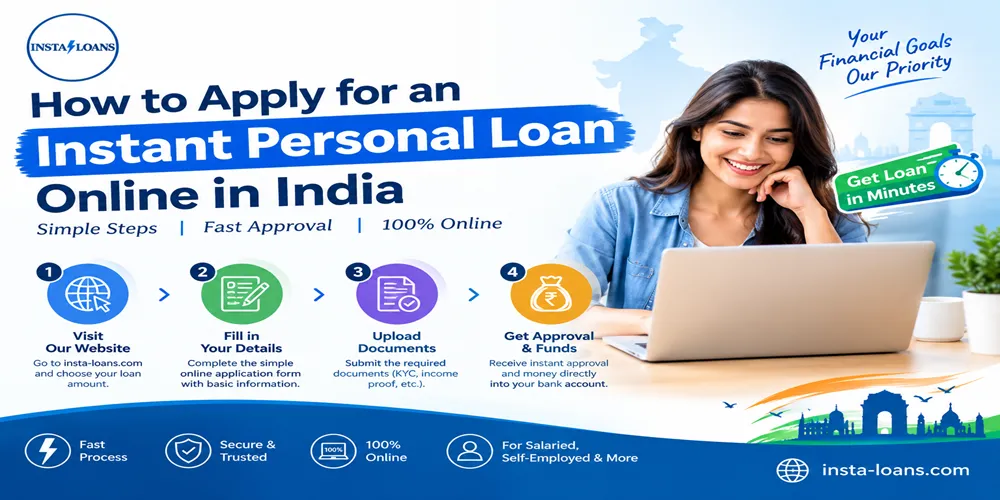
A sudden medical bill, a wedding expense that's crept up faster than planned, a home repair that can't wait, or simply the gap between one salary and the next — these are the moments when an instant personal loan can genuinely help. In India, applying for a personal loan no longer means standing in a bank queue with a folder of photocopies. Today, the entire journey — from checking eligibility to receiving money in your account — can happen on your phone in under an hour.
This guide walks you through exactly how the online personal loan process works in India: who qualifies, what documents you need, how the application unfolds step by step, and what to watch out for so you borrow responsibly and don't overpay.
What Is an Instant Personal Loan?
An instant personal loan is an unsecured loan — meaning you don't have to pledge any collateral like property or gold — that is approved and disbursed quickly, often within minutes to a few hours, through a fully digital application process. Because there's no asset backing the loan, lenders rely on your income, credit history, and repayment behaviour to decide how much to lend you and at what interest rate.
These loans are typically used for:
● Medical emergencies
● Travel or wedding expenses
● Home renovation or repairs
● Debt consolidation
● Education costs
● Festival or family expenses
● Bridging a temporary cash-flow gap
Loan amounts usually range from a few thousand rupees to several lakhs, with repayment tenures stretching from a few months to five years, depending on the lender and your profile.
Why Apply Online Instead of Visiting a Branch?
The shift to digital lending in India has been driven by a few clear advantages:
Speed. Online applications use digital KYC (know-your-customer) verification, automated income checks, and instant credit bureau pulls, which collapses a process that once took days into minutes.
Convenience. You can apply from home, work, or anywhere with an internet connection — no need to take time off or stand in line.
Transparency. Reputable digital lenders display interest rates, processing fees, and repayment terms upfront, before you commit, so you can compare offers easily.
Paperless process. Most lenders now accept Aadhaar-based e-KYC and digitally signed loan agreements, removing the need for physical paperwork.
Real-time tracking. You can usually track your application status, from submission to disbursal, directly through the lender's website or app.
Who Is Eligible for an Instant Personal Loan?
While exact criteria vary by lender, most online personal loan providers in India look at a similar set of factors:
● **Age:** Typically between 21 and 60 years at the time of application.
● **Citizenship:** Must be an Indian resident.
● **Employment type:** Salaried employees at private companies, government organisations, or PSUs, and in many cases self-employed professionals or business owners, are eligible.
● **Minimum income:** Lenders usually set a minimum monthly income threshold, which can range from around ₹15,000 to ₹25,000 depending on the city and lender, though this varies widely.
● **Credit score:** A CIBIL score of 700 or above generally improves your chances of approval and a better interest rate, though some lenders do work with applicants who have a lower or limited credit history.
● **Work experience:** Many lenders ask for a minimum period of continuous employment, often six months to a year at your current job, or a longer total work history.
If you're unsure whether you meet a particular lender's criteria, most platforms, including insta-loans.com, let you check your eligibility online before you submit a full application, so it's worth doing that first.
Documents You'll Typically Need
One of the biggest advantages of applying online is how few documents are actually required. In most cases, you'll need:
1. 1. **Identity proof** — Aadhaar card, PAN card, passport, or voter ID
2. 2. **Address proof** — Aadhaar card, utility bill, rent agreement, or passport
3. 3. **Income proof** — Last 3 months' salary slips (for salaried applicants) or the last 2 years' income tax returns and bank statements (for self-employed applicants)
4. 4. **Bank statements** — Usually the last 3 to 6 months, to verify your income and spending pattern
5. 5. **A recent photograph** — Often captured directly through the app during application
6. 6. **PAN card** — Mandatory for loans above a certain amount, as per RBI and income tax regulations
Most lenders now allow you to upload these as scanned copies or clear photos directly within the application, and Aadhaar-based e-KYC can often verify your identity and address instantly.
Step-by-Step: How to Apply for an Instant Personal Loan Online
Here is what the typical journey looks like, from start to finish:
Step 1: Check Your Eligibility
Before filling out a full application, use an online eligibility checker (available on most lending platforms) by entering basic details like your age, income, city, and employment type. This gives you an estimated loan amount and interest rate range without affecting your credit score, since it usually involves only a soft enquiry.
Step 2: Compare Offers
Don't apply to the first lender you find. Compare interest rates, processing fees, prepayment charges, and tenure options across a few platforms. Even a difference of 2-3% in interest rate can add up to a meaningful amount over the life of the loan.
Step 3: Fill Out the Application Form
Once you've chosen a lender, you'll fill out an online form with your personal details (name, date of birth, address), employment details (employer name, monthly income, work experience), and the loan amount and tenure you're seeking.
Step 4: Complete e-KYC Verification
You'll typically verify your identity using Aadhaar-based e-KYC, either through an OTP sent to your Aadhaar-linked mobile number or a quick video KYC call. PAN verification is usually done simultaneously.
Step 5: Upload Supporting Documents
Upload your income proof and bank statements as requested. Many lenders use account aggregator frameworks or allow you to securely link your bank account for instant statement verification, which speeds up the process considerably.
Step 6: Loan Approval and Offer
Based on your credit score, income, and the documents submitted, the lender's system evaluates your application — often within minutes for well-qualified applicants. You'll then see the final loan offer: amount, interest rate, tenure, EMI, and any processing fee.
Step 7: Accept Terms and E-Sign the Agreement
If you're happy with the offer, you accept the terms and digitally sign the loan agreement, usually via an Aadhaar-based e-signature.
Step 8: Disbursal
Once everything is verified and signed, the loan amount is disbursed directly to your bank account. For many digital lenders, this happens within minutes to a few hours; for others, it may take up to 1-2 business days.
Banks vs NBFCs vs Fintech Lending Apps: Who Should You Choose?
Once you start comparing lenders, you'll notice that offers come from three broad categories, and each has its own strengths.
Banks tend to offer lower interest rates to applicants with strong credit scores and stable, well-documented income, but their approval process can be stricter and sometimes slower, especially for self-employed applicants or those with a thinner credit file.
NBFCs (Non-Banking Financial Companies) often have more flexible eligibility criteria and faster turnaround times than traditional banks, making them a good fit for first-time borrowers or those with a moderate credit score. Interest rates can be slightly higher to offset the added risk.
Fintech lending platforms and apps are usually the fastest, with much of the process — application, KYC, approval, and disbursal — happening entirely within an app or website, sometimes in under 30 minutes. These are especially useful for smaller, short-tenure loans and genuine emergencies, though it's worth comparing their rates and fees carefully since convenience can come at a premium.
There's no single "best" category — the right choice depends on how quickly you need the funds, your credit profile, and how much you're borrowing.
Understanding Your EMI Before You Borrow
Before accepting any loan offer, it helps to understand what your Equated Monthly Instalment (EMI) actually represents: a fixed monthly payment that covers both a portion of the principal you borrowed and the interest charged on the outstanding balance. Most lenders display an EMI calculator on their website, letting you enter the loan amount, interest rate, and tenure to instantly see your monthly payment.
As a general rule, financial planners suggest keeping your total EMI obligations (across all loans and credit cards combined) under roughly 40-50% of your monthly take-home income, so you have enough room for regular expenses, savings, and unexpected costs. If your EMI calculation pushes you close to or beyond that range, consider either borrowing a smaller amount or choosing a longer tenure to bring the monthly payment down — keeping in mind that a longer tenure usually means paying more interest overall.
After You Apply: What Happens Next
Once your application is submitted, most lenders will keep you updated through SMS, email, or in-app notifications at each stage — application received, documents under verification, approved, and disbursed. If any document is unclear or missing, the lender will typically reach out for a resubmission rather than rejecting the application outright, so it's worth keeping an eye on your registered email and phone for any such requests.
After disbursal, you'll usually receive a loan statement or repayment schedule showing your EMI due dates, outstanding balance, and total interest payable over the tenure. Setting up an auto-debit mandate (NACH) from your bank account is a simple way to avoid missed payments and the penalty charges that come with them.
Is an Instant Personal Loan Right for You?
An instant personal loan is a useful tool when you have a genuine, time-sensitive need and a clear ability to repay it through your regular income. It's less suited to discretionary spending that could instead be saved up for, since the interest cost adds to the overall expense. Before applying, it's worth asking yourself three simple questions: Do I need this amount urgently? Can I comfortably manage the EMI alongside my existing expenses? And have I compared at least two or three offers to make sure I'm getting a fair rate? If the answers point in the right direction, an online personal loan can bridge the gap quickly and with minimal hassle.
What Affects Your Loan Approval and Interest Rate?
A few factors tend to carry the most weight:
● **Credit score and credit history:** A strong, consistent repayment history on past loans or credit cards works in your favour.
● **Income stability:** A steady, verifiable income source reassures lenders that you can manage EMIs comfortably.
● **Existing debt obligations:** Lenders look at your debt-to-income ratio — if a large chunk of your income already goes toward other EMIs, it can affect how much more you're offered.
● **Employer and employment type:** Working with a well-established employer or having a longer, stable work history can sometimes improve your terms.
● **Loan amount and tenure requested:** Asking for an amount well within your repayment capacity, with a realistic tenure, improves approval odds.
Tips for a Smoother, Faster Approval
● **Keep your KYC documents updated**, especially your Aadhaar-linked mobile number, since OTP verification depends on it.
● **Check your credit report in advance** and clear any small outstanding dues that might be dragging your score down.
● **Apply for a realistic loan amount** based on your income, rather than the maximum you might be offered.
● **Avoid applying to multiple lenders simultaneously**, since several hard credit enquiries in a short span can temporarily lower your credit score.
● **Double-check all details before submitting**, since mismatched information (like an address that doesn't match your documents) can cause delays.
Common Mistakes to Avoid
● **Not reading the fine print:** Always check the processing fee, prepayment or foreclosure charges, and late-payment penalties before accepting an offer.
● **Borrowing more than you need:** A larger loan means a larger EMI commitment, so borrow based on your actual requirement, not the maximum eligibility shown.
● **Ignoring the total cost of the loan:** Look at the total repayment amount (principal plus interest and fees), not just the EMI, to understand what the loan actually costs you.
● **Skipping comparison:** Interest rates and fees can vary meaningfully between lenders for the same profile, so it pays to compare before committing.
● **Missing EMI payments:** Late payments can lead to penalty charges and negatively affect your credit score, making future borrowing more expensive.
How insta-loans.com Can Help
insta-loans.com is built to simplify exactly this journey — helping you understand your eligibility, compare loan options, and move through a digital application process designed for speed and clarity. Whether you're applying for the first time or comparing options against an existing offer, the goal is to give you a straightforward, transparent path from application to disbursal, with clear information on rates, fees, and terms at every step.
Final Thoughts
Applying for an instant personal loan online in India today is faster and more transparent than it has ever been — but speed shouldn't come at the cost of making an informed decision. Take a few minutes to check your eligibility, compare your options, read the terms carefully, and borrow an amount that fits comfortably within your monthly budget. Done right, an online personal loan can be a genuinely useful financial tool for managing life's unplanned moments.
Frequently Asked Questions
1. How quickly can I get an instant personal loan online in India?
For many digital lenders, approval can happen within minutes and disbursal within a few hours, provided your documents are in order and you meet the eligibility criteria. Some cases may take up to 1-2 business days depending on the lender's verification process.
2. What credit score do I need for an instant personal loan?
Most lenders prefer a CIBIL score of 700 or above for the best rates, but some digital lenders do consider applicants with a lower or limited credit history, often at a higher interest rate.
3. Can I get a personal loan without salary slips?
Yes, in many cases. Self-employed applicants can often submit income tax returns and bank statements instead of salary slips as proof of income.
4. Is it safe to apply for a personal loan online?
Yes, as long as you apply through a legitimate, RBI-compliant lender or a registered NBFC. Look for secure (HTTPS) websites, clear disclosure of fees and interest rates, and avoid lenders who ask for upfront payments before disbursal.
5. Will checking my eligibility affect my credit score?
No. Eligibility checks typically involve a soft credit enquiry, which does not impact your credit score. A full loan application, however, usually involves a hard enquiry.
6. Can I prepay or foreclose my personal loan early?
Most lenders allow prepayment or foreclosure after a minimum lock-in period, though some charge a prepayment fee. It's worth checking this clause before accepting a loan offer.
7. What is the maximum amount I can borrow through an instant personal loan?
This depends on your income, credit profile, and the lender's policies, but online personal loans in India commonly range from a few thousand rupees up to ₹5 lakh or more for well-qualified applicants.