Autonomous Lending System for NBFCs in India: The Complete Guide
By Roopya
60 Views
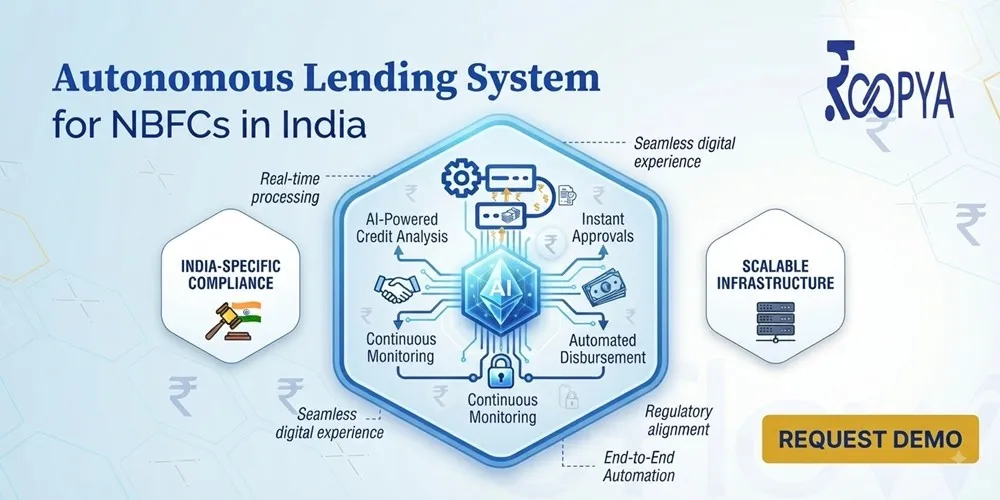
India's NBFC sector is at a pivotal inflection point. With over 9,500 registered non-banking financial companies operating across the country, the competition for quality borrowers has never been more intense — while regulatory expectations have never been more demanding. In this environment, the NBFCs that will define the next decade of Indian lending are not those with the deepest pockets or the largest branch networks. They are the ones that have built the most intelligent, automated, and scalable lending operations.
The term 'autonomous lending system' describes precisely this ambition: a lending infrastructure in which every stage of the loan lifecycle — from the moment a borrower applies, through underwriting, disbursement, repayment, and collections — is powered by artificial intelligence, machine learning, and automated decision engines, with minimal human intervention required for routine transactions.
This is not a futuristic concept. Roopya has made autonomous lending a deployable reality for Indian NBFCs today — with a no-code platform that goes live in one day and handles the entire lending lifecycle end to end. This guide explains what autonomous lending systems are, why they matter for Indian NBFCs specifically, how they work, and what to look for when choosing the right platform for your institution.
1. What Is an Autonomous Lending System?
An autonomous lending system is a fully integrated digital platform that automates and intelligently orchestrates every stage of the lending process without requiring constant human intervention. It combines several layers of technology — artificial intelligence, machine learning, robotic process automation, rules engines, API integrations, and data analytics — into a unified infrastructure that can make complex lending decisions at scale and at speed.
The word 'autonomous' is deliberate. Unlike traditional loan management software, which digitises manual processes, an autonomous lending system actively replaces manual decision-making with algorithm-driven intelligence. It doesn't just send reminders for upcoming EMIs — it predicts which borrowers are at risk of default and initiates proactive interventions. It doesn't just collect application data — it analyses it against hundreds of variables in milliseconds and generates a credit decision with a full audit trail.
For an NBFC operating in India's complex regulatory and borrower landscape, an autonomous lending system represents the highest level of lending technology maturity — and increasingly, the minimum viable standard for institutions that want to compete at scale.
2. Why Indian NBFCs Need Autonomous Lending Systems Now
2.1 The Scale of India's Lending Opportunity
India's formal credit gap is estimated at over $500 billion. MSMEs, self-employed individuals, agricultural households, and young urban professionals are chronically underserved by traditional banking. NBFCs have historically been the primary vehicle for reaching these segments — and with digital penetration accelerating across Tier 2, 3, and 4 cities, the opportunity to serve new borrowers through digital channels is enormous.
But seizing this opportunity requires volume. An NBFC cannot profitably serve thin-file borrowers, low-ticket loans, or high-frequency credit products using manual processes. The economics simply do not work. Autonomous lending systems change the unit economics of lending by dramatically reducing the cost per loan processed — making it viable to lend at scale to segments that were previously too expensive to serve.
2.2 Regulatory Pressure and Compliance Demands
The Reserve Bank of India has progressively tightened its oversight of the NBFC sector. Fair Practice Code compliance, digital lending guidelines issued in 2022, data localisation requirements, mandatory credit bureau reporting, KYC norms under PMLA — the compliance burden on NBFCs is growing rapidly. Manual compliance management is not scalable. An autonomous lending system bakes compliance into every transaction automatically — generating audit trails, triggering mandatory disclosures, and producing regulatory reports without human intervention.
2.3 Borrower Expectations Have Fundamentally Shifted
The post-pandemic Indian borrower — regardless of geography or income level — has experienced the convenience of digital services across every aspect of their lives. They expect loan applications to be completed on a mobile phone, KYC to happen in minutes, credit decisions to be instant, and disbursements to arrive within hours. An NBFC that still operates a week-long manual underwriting process is not meeting these expectations — and is losing customers to competitors who are.
2.4 Talent and Capacity Constraints
Skilled credit analysts, underwriters, and collections managers are expensive, difficult to hire, and hard to scale rapidly. An NBFC experiencing fast growth cannot simply hire its way to greater processing capacity. Autonomous lending systems allow institutions to scale loan volume without proportional increases in headcount — handling ten times the applications with the same team, by automating routine decisions and reserving human judgment for complex edge cases.
3. Core Components of a World-Class Autonomous Lending System
3.1 Intelligent Loan Origination Engine
The origination module is where the autonomous lending journey begins. It encompasses everything from the digital application form through document collection, KYC verification, bureau score retrieval, and initial eligibility determination. An autonomous origination engine handles all of this without human involvement for clean, straightforward applications — which typically represent 60–80% of any NBFC's application volume.
Roopya's origination platform offers 20+ pre-configured loan product journeys — personal loans, business loans, MSME credit, gold loans, home loans, auto loans, payday products, and microfinance — each with product-specific workflows, document requirements, and eligibility criteria. A new product can be configured and launched without writing a single line of code.
3.2 Automated KYC and Identity Intelligence
Identity verification is a mandatory bottleneck in traditional lending. Autonomous lending systems eliminate this bottleneck by integrating directly with Aadhaar eKYC, NSDL PAN verification, Digilocker, Video KYC (VKYC), and face-match providers. The entire KYC process — which might take days in a branch-based model — is completed in under 90 seconds on Roopya's platform.
Beyond basic identity verification, modern autonomous systems also perform liveness detection, face-match against ID documents, geolocation validation, device fingerprinting, and negative list screening — all automatically, as part of the onboarding flow.
3.3 Multi-Bureau Credit Intelligence
An autonomous lending system simultaneously pulls credit reports from multiple bureaus — CIBIL, Experian, CRIF High Mark, and Equifax — the moment consent is provided. It parses these reports automatically, computing credit scores, delinquency histories, utilisation ratios, and inquiry patterns. This multi-bureau intelligence feeds directly into the credit decisioning engine, enriching the risk assessment with the most complete picture of the borrower's credit behaviour available.
Roopya's pre-integrated bureau connections cover all four major bureaus and the CIBIL MSME Rank (CMR) for business lending — all available out of the box, without separate API contracts or integration work.
3.4 AI-Powered Document Processing and Fraud Detection
Document verification is one of the most labour-intensive steps in traditional lending. An autonomous system applies AI-driven OCR (Optical Character Recognition) and NLP (Natural Language Processing) to extract, verify, and analyse every document submitted — bank statements, salary slips, GST returns, ITRs, property documents — with 99%+ accuracy and in seconds rather than hours.
Equally important is fraud detection. Roopya's AI fraud modules check for document tampering, identity spoofing, synthetic identities, and collusion patterns across applications — flagging suspicious cases for human review while allowing clean applications to proceed automatically. Industry data shows that AI-based fraud detection reduces fraudulent disbursements by up to 80% compared to manual review processes.
3.5 No-Code Business Rule Engine with Machine Learning
The Business Rule Engine (BRE) is the brain of an autonomous lending system. It is the mechanism through which an NBFC's credit policy — its eligibility criteria, risk appetite, product-level parameters, and approval thresholds — is translated into automated decisioning logic. A world-class BRE allows credit and risk teams to configure complex, multi-variable rules through a visual interface, without technical expertise.
Roopya's BRE goes further: it is self-learning. Machine learning models embedded in the engine analyse historical approval and rejection data, portfolio performance outcomes, and market conditions to continuously suggest rule improvements. The BRE identifies patterns that human analysts might miss — such as the correlation between specific income source types and repayment behaviour — and surfaces these as actionable insights for the credit team to review and implement.
3.6 Real-Time Autonomous Credit Decisioning
The decisioning module is where an autonomous lending system delivers its most dramatic value. For clean applications that meet all configured criteria, an instant automated decision — approve, reject, or conditional approve with specific terms — is generated in milliseconds. For borderline cases or applications triggering exception rules, the system routes to a human underwriter with a pre-populated decision support package, dramatically reducing the time required for manual review.
Roopya's platform processes credit decisions in real time, with the option to configure fully automated straight-through processing for low-risk product segments, or hybrid human-in-the-loop workflows for higher-ticket or more complex lending products.
3.7 Digital Loan Agreement and eSign
Once a loan is approved, the autonomous system generates a personalised loan agreement, sanction letter, and MITC (Most Important Terms and Conditions) document automatically — pre-populated with the approved terms. The borrower completes legally valid execution via Aadhaar OTP-based or Digilocker-based eSign, without printing or posting a single document. The signed documents are stored in the system with a complete chain of custody for regulatory and legal purposes.
3.8 Automated Loan Management and Servicing
Post-disbursement, an autonomous lending system takes over the full servicing lifecycle. It generates amortisation schedules, triggers payment reminders via SMS and WhatsApp at configurable intervals, processes NACH mandates and UPI AutoPay collections, handles partial payments, calculates penal interest on late payments, and updates the loan ledger — all without manual intervention. Roopya's loan management module supports complex loan structures including step-up EMIs, moratorium periods, bullet repayments, and revolving credit facilities.
3.9 AI-Driven Collections and Early Warning System
Collections is where many NBFCs haemorrhage value. An autonomous lending system applies predictive analytics to identify borrowers showing early signs of financial stress — changes in account behaviour, missed utility payments visible through AA data, declining repayment consistency — before they miss an EMI. Roopya's Early Warning System generates risk flags and triggers pre-delinquency interventions automatically, including personalised outreach messages, restructuring offers, and agent assignment for high-risk accounts.
For accounts that do enter delinquency, Roopya's automated collections engine configures and executes collection strategies based on Days Past Due (DPD), product type, and borrower risk profile — optimising recovery rates while minimising the cost of collections.
3.10 Embedded Finance and Open API Architecture
A truly autonomous lending system is not a closed portal — it is an open platform that can be embedded wherever lending needs to happen. Roopya's open API architecture allows NBFCs to offer loan products directly within partner apps, e-commerce platforms, employer portals, or fintech interfaces — without redirecting the borrower to a separate lender interface. This embedded finance capability opens new origination channels and dramatically expands addressable market reach.
4. Autonomous Lending vs. Traditional Digital Lending: The Key Differences
It is important to distinguish between an autonomous lending system and a basic digital lending platform. Many NBFCs have adopted digital tools — online application forms, digital document uploads, or basic loan management software — without achieving true automation. Here is how the two differ:
● Decision-making: Traditional digital platforms digitise the application but still require human underwriters to make credit decisions. Autonomous systems make decisions algorithmically, with human review reserved for exceptions only.
● Scalability: Digital platforms scale linearly — more applications require more staff. Autonomous systems scale exponentially — doubling application volume requires minimal additional resources.
● Intelligence: Traditional platforms execute predefined rules. Autonomous systems learn from data, improve their models continuously, and adapt to changing risk conditions without manual rule updates.
● Integration depth: Traditional platforms may connect to one or two data sources. Autonomous systems integrate with 300+ data providers — bureaus, bank account aggregators, GST systems, e-commerce platforms, employment databases — to build a richer, more accurate borrower profile.
● Fraud resilience: Traditional platforms rely on document review by humans. Autonomous systems apply AI fraud detection across every data point, identifying sophisticated fraud patterns that human reviewers routinely miss.
5. The Account Aggregator Advantage in Autonomous Lending
India's Account Aggregator (AA) framework — governed by the RBI and operational since 2021 — is one of the most significant enablers of autonomous lending in the country. The AA system allows borrowers to share their financial data — bank statements, mutual fund portfolios, insurance policies, and pension accounts — directly with lenders through a secure, consent-based, RBI-regulated data-sharing protocol.
For autonomous lending systems, AA integration is transformative. Instead of asking borrowers to manually upload and submit bank statements — a process that introduces delays, fraud risk, and drop-off — an AA-enabled platform pulls verified, structured financial data directly from the borrower's bank, in real time, with the borrower's consent. This data is then automatically parsed by the AI engine to compute income, obligation ratios, cash flow stability, and creditworthiness — without a human touching a single document.
The result is a loan application process that is simultaneously faster, more accurate, and more fraud-resistant than any manual process can achieve. Roopya's platform is fully AA-integrated, making it one of the few lending infrastructure providers in India to offer native AA-enabled underwriting across all product types.
6. Roopya: India's Autonomous Lending System for NBFCs
Roopya was purpose-built for the Indian NBFC market. Its founding vision — to deliver autonomous lending systems on a no-code infrastructure — addresses the specific challenges of Indian lenders: regulatory complexity, diverse product requirements, variable data quality, and the need to serve a fragmented, multilingual borrower base.
What Makes Roopya Different
● 1-Day Go-Live: Roopya's pre-built product journeys, plug-and-play API integrations, and no-code configuration environment allow NBFCs to go live with a fully operational autonomous lending system in 24 hours. No six-month implementation. No large upfront IT investment.
● 300+ Pre-Integrated APIs: Every major credit bureau, KYC provider, eSign platform, payment gateway, NACH service, accounting system, and banking API is pre-connected. NBFCs inherit a complete data ecosystem from day one.
● Truly No-Code Platform: Credit managers, risk officers, and business users configure credit policies, product parameters, collection workflows, and reporting dashboards — with zero developer dependency. This means faster response to market changes and regulatory updates.
● Pay-As-You-Use Pricing: Zero upfront licence fees. NBFCs pay based on actual transaction volume, making Roopya accessible for institutions at every stage of growth — from newly licensed entities to established lenders processing thousands of cases daily.
● AI Throughout the Stack: Document intelligence, credit scoring, fraud detection, early warning, collections optimisation, and portfolio analytics — AI is embedded at every stage, not bolted on as an afterthought.
● Full RBI Compliance: The platform is continuously updated for the latest RBI guidelines. Audit trails, digital consent logs, CERSAI integration, bureau reporting, and regulatory dashboard outputs are all built in.
● Trusted by Modern Lenders: IndiaKaLoan, QuickFinShop, Recapita, Findoc, EazyCredit, and Lona Seva are among the NBFCs and fintechs that have built their autonomous lending operations on Roopya.
7. ROI of Implementing an Autonomous Lending System
The business case for autonomous lending systems is compelling and measurable. Here is what Roopya-powered NBFCs typically experience:
● 10x Faster Processing: AI-powered document processing reduces verification time from hours to seconds. Complete loan applications are processed in under 15 minutes for clean profiles.
● 40-60% Lower Operational Costs: Automation of KYC, document verification, credit decisioning, and collections reminders reduces the cost per loan processed dramatically.
● 40% Better Credit Accuracy: ML-powered credit scoring consistently outperforms traditional rule-based or manual underwriting — reducing NPAs and improving portfolio quality.
● 80% Fraud Reduction: AI-driven fraud detection catches sophisticated fraud patterns before disbursement, protecting the NBFC's portfolio from first-payment defaults and identity fraud.
● 60% Better Collections Recovery: AI-optimised collection strategies, targeting the right borrower with the right intervention at the right time, improve recovery rates significantly.
● 24/7 Continuous Operation: Unlike human teams, autonomous systems process applications, run collections workflows, and generate reports around the clock — with no downtime.
8. Implementation Roadmap for NBFCs Moving to Autonomous Lending
For NBFCs considering the transition to an autonomous lending system, the journey typically follows four phases:
● Phase 1 — Digital Foundation (Week 1): Go live on Roopya's platform with a core loan product. Configure application forms, KYC workflows, bureau integrations, and basic BRE rules. Begin processing digital applications immediately.
● Phase 2 — Automation Depth (Month 1-2): Enable full straight-through processing for eligible application segments. Activate AI document analysis, multi-bureau pulls, and AA-based bank statement analysis. Configure automated collection workflows.
● Phase 3 — Intelligence Layer (Month 2-4): Deploy custom credit scorecards. Activate the Early Warning System for proactive delinquency management. Enable predictive portfolio analytics and automated regulatory reporting.
● Phase 4 — Embedded Finance and Scale (Month 4+): Open API channels for DSA networks, fintech partners, and embedded finance integrations. Enable multi-product origination and cross-sell workflows. Leverage AI insights for continuous credit policy optimisation.
9. The Future of Autonomous Lending in India
Several macro trends will intensify the importance of autonomous lending systems for Indian NBFCs over the next three to five years. The ONDC (Open Network for Digital Commerce) is expected to create new demand signals that lenders can integrate into credit decisions. The OCEN (Open Credit Enablement Network) framework will standardise the API architecture for loan product delivery across platforms. The AA ecosystem will expand to cover additional data categories — telecom, utilities, and GSTN data — enriching the inputs available to autonomous credit models.
Generative AI will reshape borrower communication, enabling truly personalised, conversational loan journeys that can be delivered in any Indian language — dramatically improving conversion rates and borrower experience in Tier 2 and Tier 3 markets.
Regulatory technology (RegTech) will increasingly be embedded within lending platforms, with real-time compliance monitoring, automated suspicious transaction reporting, and AI-driven stress testing becoming standard capabilities rather than optional add-ons.
In this environment, NBFCs that invest in autonomous lending infrastructure today are not just optimising current operations — they are building the capability foundation for the next decade of competitive advantage in Indian lending.
10. Conclusion: Why Autonomous Lending Is No Longer Optional for Indian NBFCs
The lending landscape in India is moving fast — faster than any institution can navigate with manual processes. The NBFCs that will lead the next phase of India's credit expansion are those that have built autonomous, intelligent lending operations that can scale without limits, comply without effort, and serve borrowers without friction.
Roopya's autonomous lending system gives Indian NBFCs precisely this capability — deployable in a day, powered by AI throughout, and continuously updated for a changing regulatory environment. Whether you are a newly licensed NBFC building your first loan product or an established institution ready to transform your legacy operations, Roopya provides the infrastructure to compete and win.
Request a free demo today and discover why India's most innovative lenders are choosing Roopya as their autonomous lending platform of choice.