Best NBFC Software in India: Features, Benefits & Comparison
By Roopya
183 Views
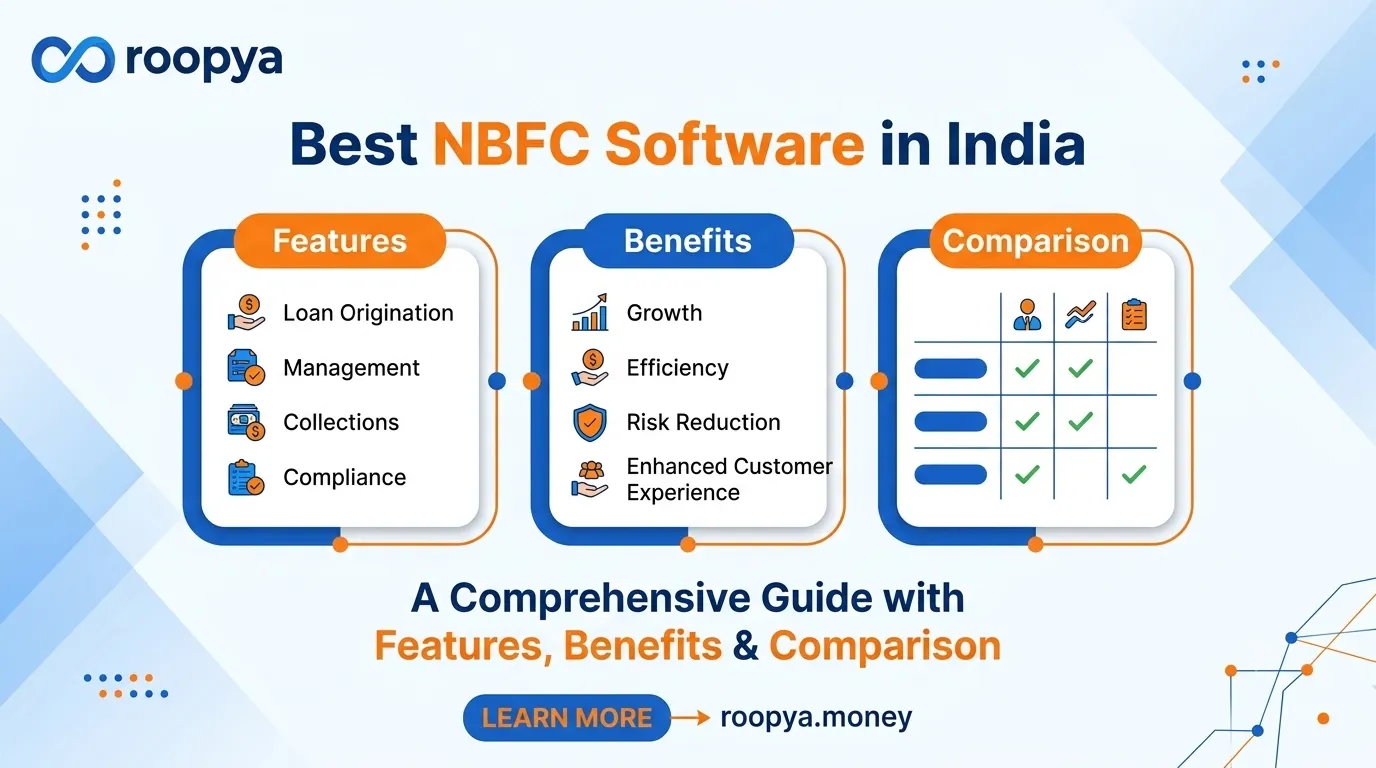
Non-Banking Financial Companies (NBFCs) have become one of the fastest-growing pillars of India's credit ecosystem. From microfinance and gold loans to vehicle finance, personal loans, and MSME lending, NBFCs now serve millions of borrowers who were traditionally underserved by banks. But as loan books grow and regulatory scrutiny from the RBI tightens, running an NBFC on spreadsheets, disconnected tools, or outdated legacy systems is no longer sustainable.
This is where NBFC software - more specifically, a robust Loan Management System (LMS) - becomes the backbone of the business. Choosing the right platform can mean the difference between scaling smoothly and drowning in manual errors, compliance risk, and customer complaints. In this guide, we break down what NBFC software actually does, the features that matter most, the real business benefits, and how to compare platforms before you commit to one.
What Is NBFC Software?
NBFC software is a purpose-built digital platform that manages the entire lending lifecycle - from loan origination and underwriting to disbursement, collections, accounting, and regulatory reporting. Unlike generic banking software, NBFC software is designed around the specific products, risk models, and compliance requirements that apply to non-banking lenders in India.
A modern NBFC software suite typically includes:
● A Loan Origination System (LOS) to capture applications, run credit checks, and approve loans
● A Loan Management System (LMS) to service active loans, track EMIs, and manage repayments
● A Collections module to handle overdue accounts, reminders, and recovery workflows
● Accounting and finance tools aligned with Ind AS and RBI norms
● Reporting and compliance dashboards for regulatory filings and audits
● Customer-facing portals or apps for self-service and transparency
Together, these modules replace what used to be a patchwork of Excel sheets, manual registers, and disconnected point solutions.
Why NBFCs in India Need Specialized Software
India's NBFC sector is not just growing - it is diversifying. Digital lenders, gold loan companies, vehicle financiers, and co-lending partnerships are all operating under one regulatory umbrella but with very different operational needs. A few reasons specialized software has become essential:
1. Regulatory complexity is increasing. The RBI's scale-based regulation (SBR) framework, tighter KYC norms, and evolving reporting formats
mean NBFCs must generate accurate, timely reports without manual rework every time a rule changes.
2. Loan books are growing faster than headcount. Manual processing simply cannot keep pace with thousands of monthly applications, especially for NBFCs expanding into new geographies or partnering with fintechs for co-lending.
3. Borrower expectations have shifted. Customers now expect instant approvals, digital KYC, online repayment options, and real-time visibility into their loan status - expectations shaped by banks and fintech apps.
4. Risk management needs real-time data. Delinquency tracking, early-warning signals, and portfolio-level risk analysis are far more effective when built into the software rather than reconstructed after the fact from raw data exports.
5. Multi-branch and multi-product operations need centralization. NBFCs operating across states or offering multiple loan products (personal, business, gold, vehicle) need a single source of truth rather than siloed systems per branch or product line.
Key Features to Look for in NBFC Software
Not all loan management systems are built equally. When evaluating NBFC software, here are the features that genuinely move the needle:
1. End-to-End Loan Lifecycle Management
The software should cover the full journey - application, credit appraisal, sanction, disbursement, servicing, and closure - without requiring data to be re-entered across separate tools.
2. Configurable Loan Products
NBFCs rarely offer just one type of loan. Look for software that lets you configure interest calculation methods (flat, reducing balance), tenure structures, processing fees, and penalty rules without needing a developer every time you launch a new product.
3. Automated Credit Underwriting
Rule-based and score-based underwriting engines that pull bureau data (CIBIL, Experian, CRIF), apply eligibility rules, and flag exceptions save enormous manual effort and reduce inconsistent decision-making.
4. Digital KYC and Document Management
Integration with Aadhaar-based e-KYC, PAN verification, and digital document storage speeds up onboarding while keeping audit trails intact.
5. Collections and Recovery Management
A strong collections module should support bucket-wise tracking (0-30, 31-60, 61-90+ days), automated reminders via SMS/WhatsApp/email, field agent allocation, and settlement workflows.
6. Accounting and General Ledger Integration
The system should automatically post accounting entries for disbursements, EMI collections, interest accruals, and write-offs - reducing the reconciliation burden on the finance team.
7. Regulatory and MIS Reporting
Pre-built templates for RBI returns, NPA classification (as per IRAC norms), and portfolio-level MIS dashboards help compliance and management teams alike.
8. Multi-Branch and Role-Based Access
As NBFCs scale across branches or states, the software needs granular role-based permissions so branch staff, credit managers, and auditors each see only what's relevant to them.
9. API-First Architecture
Modern NBFC software should offer APIs for integration with payment gateways, credit bureaus, e-KYC providers, accounting software, and co-lending partners - rather than operating as a closed system.
10. Cloud Hosting and Data Security
Given the sensitivity of financial and personal data, look for platforms hosted on secure cloud infrastructure with encryption, role-based access controls, and regular audit logging.
Benefits of Using Dedicated NBFC Software
Faster Loan Processing
Automation of credit checks, document verification, and approval workflows can cut loan turnaround time from days to hours, directly improving customer satisfaction and conversion rates.
Reduced Operational Costs
By eliminating manual data entry, reconciliation, and paper-based processes, NBFCs can manage larger loan books without proportionally increasing headcount.
Improved Compliance and Audit Readiness
Automated regulatory reports and built-in audit trails reduce the risk of penalties and make RBI inspections and internal audits far less stressful.
Better Risk Visibility
Real-time dashboards on delinquency, portfolio quality, and early-warning indicators allow management to intervene before small issues become large losses.
Stronger Customer Experience
Self-service portals, transparent repayment schedules, and faster approvals build trust and improve retention - increasingly important as borrowers compare NBFCs to slicker fintech alternatives.
Scalability Across Products and Geographies
A well-architected LMS grows with the business, supporting new loan products, new branches, and new partnership models (like co-lending with banks) without requiring a system overhaul.
Data-Driven Decision Making
Centralized data means management gets a single, reliable view of the business - critical for board reporting, fundraising, and strategic planning.
How to Compare NBFC Software Before You Choose
With dozens of vendors in the market, comparison should go beyond a feature checklist. Here's a practical framework:
Evaluation Criteria
What to Check
Product coverage
Does it support your specific loan types (gold, vehicle, MSME, personal, microfinance)?
Configurability
Can you launch a new product or change interest logic without vendor intervention or long dev cycles?
Compliance readiness
Are RBI reporting formats and IRAC norms built in and kept updated?
Integration ecosystem
Does it offer APIs for bureaus, payment gateways, e-KYC, and accounting systems?
Scalability
Can it handle your projected loan book growth over the next 3-5 years?
Implementation time
How long does onboarding typically take, and what support is provided?
Total cost of ownership
Look beyond license fees - factor in implementation, customization, and support costs.
Data security
Is data encrypted, hosted securely, and compliant with data protection expectations?
Vendor track record
Does the vendor have experience specifically with NBFCs and Indian regulatory requirements?
Customer support
What is the responsiveness and expertise of the support team, especially during audits or system issues?
A useful exercise is to request a live demo focused on your actual loan products rather than a generic walkthrough - this reveals how configurable the system truly is in practice.
Common Mistakes NBFCs Make When Choosing Software
● Choosing based on price alone, without evaluating long-term scalability or hidden implementation costs
● Ignoring compliance features, assuming reports can always be generated manually as a workaround
● Ignoring integration needs, resulting in a system that becomes another data silo instead of a central hub
● Underestimating training and change management, causing poor adoption even after a good system is purchased
● Not validating with real data, since demos with sample data often hide edge cases that appear once real loan portfolios are loaded
Why Roopya.money Is Built for Indian NBFCs
Roopya.money is a loan management system designed specifically for the operational and regulatory realities of Indian banks and NBFCs. Rather than adapting a generic international platform, Roopya.money is built around Indian lending workflows - from configurable loan products and automated underwriting to collections management and RBI-aligned compliance reporting.
For NBFCs looking to modernize their lending operations without a lengthy, disruptive overhaul, Roopya.money offers a centralized platform that brings origination, servicing, collections, accounting, and reporting together - reducing the operational drag of juggling multiple disconnected tools.
The right NBFC software is not just a back-office upgrade - it's a strategic decision that shapes how fast an NBFC can grow, how well it manages risk, and how smoothly it stays compliant with an evolving regulatory landscape. As competition intensifies and borrower expectations rise, NBFCs that invest in a robust, configurable, and compliance-ready loan management system will be better positioned to scale sustainably.
Before choosing a platform, go beyond feature lists - evaluate configurability, integration capability, compliance readiness, and vendor experience with the Indian NBFC ecosystem. The goal isn't just software that works today, but a system that can grow alongside your loan book for years to come.
Frequently Asked Questions (FAQ)
1. What is NBFC software used for?
NBFC software manages the complete lending lifecycle for non-banking financial companies, including loan origination, underwriting, disbursement, EMI servicing, collections, accounting, and regulatory reporting.
2. Is NBFC software different from banking software?
Yes. While there is overlap, NBFC software is specifically designed around the loan products, risk models, and RBI compliance requirements unique to non-banking financial companies, which differ from full-service banks.
3. What features should I prioritize when choosing NBFC software?
Prioritize configurable loan products, automated underwriting, collections management, regulatory reporting, API integrations, and role-based access control.
4. Can NBFC software help with RBI compliance?
Yes, most modern NBFC software includes built-in templates for RBI returns, NPA classification under IRAC norms, and audit trails that simplify compliance reporting.
5. How long does it take to implement NBFC software?
Implementation timelines vary based on the complexity of your loan products and data migration needs, but a well-supported platform can typically be operational within a few weeks to a couple of months.
6. Is cloud-based NBFC software secure?
Reputable cloud-based NBFC software uses encryption, role-based access, and regular security audits to protect sensitive financial and personal borrower data.
7. Can NBFC software support multiple loan products?
Yes, good NBFC software allows you to configure multiple loan products - such as personal, gold, vehicle, or MSME loans - within a single platform.
8. How does NBFC software improve collections?
It automates reminders, tracks overdue buckets, assigns field agents, and provides visibility into recovery performance, reducing delinquency and manual follow-up effort.