How exam pressure turns into a fear of failure.
By Premlata Kumar
5 Views
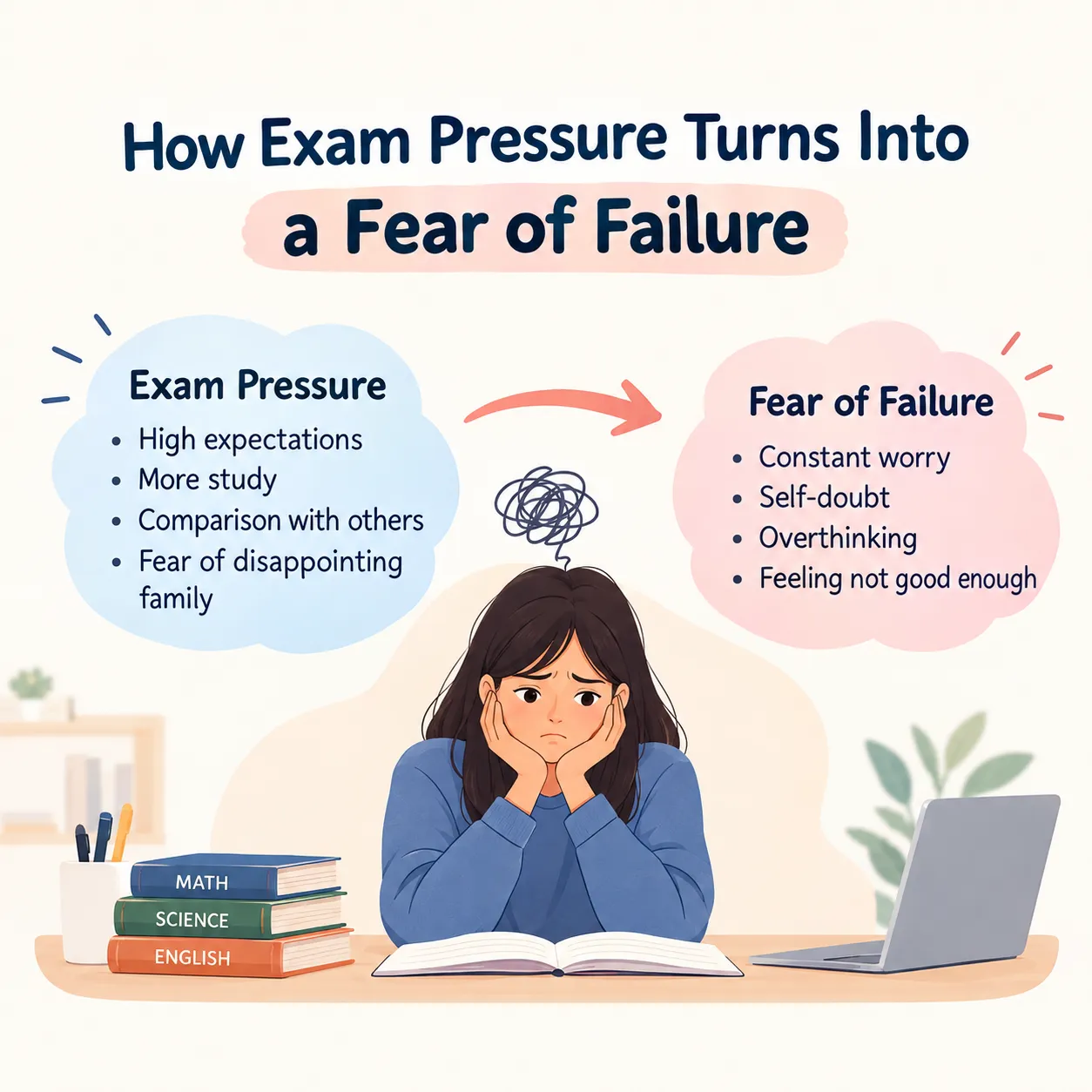
Exam pressure does not affect every student in the same way. For some, the possibility of getting a poor result gradually becomes a fear of disappointing parents, losing opportunities, or feeling unsuccessful. This is where fear of failure in students can become more than ordinary exam nervousness. It may influence how they study, respond to mistakes, make decisions, and view themselves. Understanding what is happening psychologically can help students and parents recognise when academic pressure is becoming difficult to manage.
Why Does Exam Pressure Sometimes Become Fear of Failure?
A certain amount of pressure can encourage preparation. The difficulty begins when academic performance becomes closely connected with a student's sense of personal value.
A student may start thinking:
- “What if I don't get the marks I need?”
- “Everyone will think I am not capable.”
- “My future depends on this exam.”
- “If I make one mistake, I will fail.”
These thoughts can turn exam pressure into a perceived threat rather than simply a challenge.
The student may then spend more time worrying about the outcome than focusing on the task itself. Instead of asking, “What do I need to study today?”, their attention becomes focused on “What will happen if I don't succeed?” That shift is psychologically important because it changes preparation from a learning activity into a test of self-worth.
How Does Fear of Failure Affect Student Behaviour?
One of the less obvious effects of fear of failure is that it does not always make students work harder.
Some students respond by over-preparing. Others begin avoiding the very work they are worried about.
For example, a student may:
- repeatedly revise material they already know;
- avoid difficult chapters;
- delay starting an assignment;
- constantly compare their preparation with classmates;
- seek repeated reassurance;
- abandon a task when they make an error.
This can create a cycle: fear increases avoidance, avoidance creates incomplete preparation, and incomplete preparation creates more fear. This is why simply telling a student to “study harder” may not address the underlying problem.
When Does Academic Pressure Become Student Anxiety?
Academic pressure becomes more concerning when worry starts interfering with everyday functioning.
A student may remain preoccupied with grades even when they are not studying. They may find it difficult to switch off after completing their work, repeatedly think about possible mistakes, or feel unable to tolerate uncertainty about their results.
In some cases, student anxiety may also be associated with changes in sleep, concentration, mood, motivation, or daily routines. However, occasional worry before an examination is not automatically a mental health disorder. The intensity, duration, frequency, and effect on functioning matter.
Why Can Perfectionism Make Fear of Failure Stronger?
Perfectionism is not simply “wanting to do well.”
A student with perfectionistic thinking may feel that anything less than an ideal outcome represents failure. A 90% result may therefore feel disappointing rather than successful if the student's internal standard is 100%.
This can create rigid thinking such as:
“If I cannot do it perfectly, there is no point trying.”
Such thinking can increase performance anxiety, particularly when students believe that mistakes reveal something negative about their abilities. Healthy striving allows room for mistakes and learning. Perfectionistic thinking can make mistakes feel threatening.
What Happens When Academic Performance Becomes Part of Self-Worth?
Grades provide information about performance in a particular situation. They do not provide a complete description of a person's abilities or identity. Problems can develop when students begin interpreting academic outcomes as statements about who they are:
Poor result → “I performed poorly” → “I am not capable.”
That final step is important.
When academic performance becomes closely connected with self-worth, setbacks can feel disproportionately painful. A student may become highly self-critical, withdraw after disappointing results, or become reluctant to attempt challenging opportunities because failure feels personally threatening. Helping students separate performance from identity can therefore be an important part of building psychological resilience.
How Can Overthinking Affect Preparation?
Another common pattern is spending more mental energy predicting failure than completing the work itself.
A student might repeatedly imagine different negative outcomes:
“What if I forget everything?”
“What if the paper is difficult?”
“What if everyone scores higher?”
“What if I don't get into the college I want?”
This type of overthinking can consume attention that could otherwise be used for preparation.
The practical response is not necessarily to eliminate every negative thought. A more useful approach can be learning to recognise the thought, evaluate whether it is realistic and useful, and then redirect attention toward the next controllable action.
For example:
Unhelpful focus: “What if I fail?”
More useful focus: “What is one topic I can revise properly in the next 30 minutes?”
The second question brings attention back from an uncertain future to an actionable present.
What Can Students Do When Fear Starts Controlling Their Studies?
The goal is not to remove every feeling of pressure. It is to prevent fear from becoming the main driver of behaviour.
Students can begin by:
1. Separate outcome goals from process goals
Instead of focusing only on marks or rank, define controllable targets such as completing a chapter, practising questions, or reviewing mistakes.
2. Notice all-or-nothing thinking
Words such as “always,” “never,” “perfect,” and “failure” can sometimes signal rigid thinking.
3. Treat mistakes as information
An incorrect answer can identify a knowledge gap. It does not automatically represent a lack of ability.
4. Reduce comparison
Comparing preparation hours, marks, or revision speed with classmates can increase unnecessary pressure because every student's circumstances are different.
5. Protect recovery time
Rest is not the opposite of productivity. Adequate recovery can support attention, emotional regulation, and sustainable preparation.
When Should a Student Speak With a Psychologist?
Professional support may be worth considering when academic worries become persistent or begin interfering with daily life.
For example, a student may benefit from speaking with a psychologist or counsellor when they experience ongoing distress, significant avoidance, persistent sleep difficulties, frequent emotional overwhelm, or difficulty functioning despite trying to manage the situation independently.
A mental health professional can explore what is maintaining the problem rather than focusing only on the examination itself.
How Can Counselling Help With Fear of Failure?
Counselling does not simply teach students to “stop worrying.”
A psychologist may first explore the beliefs behind the fear—for example, whether the student equates mistakes with incompetence or believes that one academic setback will determine their entire future. Depending on the individual's needs, therapy may work on patterns such as negative self-talk, perfectionistic expectations, avoidance, emotional regulation, coping skills, and healthier responses to uncertainty. Approaches such as cognitive behavioural techniques may be used when clinically appropriate. The specific approach should depend on the student's concerns and professional assessment.
Final Takeaway
Fear of failure in students is not simply about being worried about an examination. It can involve the way students interpret mistakes, evaluate themselves, respond to uncertainty, and connect achievement with personal identity.
The aim is not to remove ambition or academic goals. It is to help students develop a healthier relationship with achievement—one where a result provides feedback about performance without becoming a definition of personal worth.
When academic pressure begins affecting emotional wellbeing or everyday functioning, speaking with a qualified mental health professional can provide an opportunity to understand the underlying pattern and develop appropriate coping strategies.