Why Positive Discipline Works in Early Childhood Classrooms
By Yogi Patel
51 Views
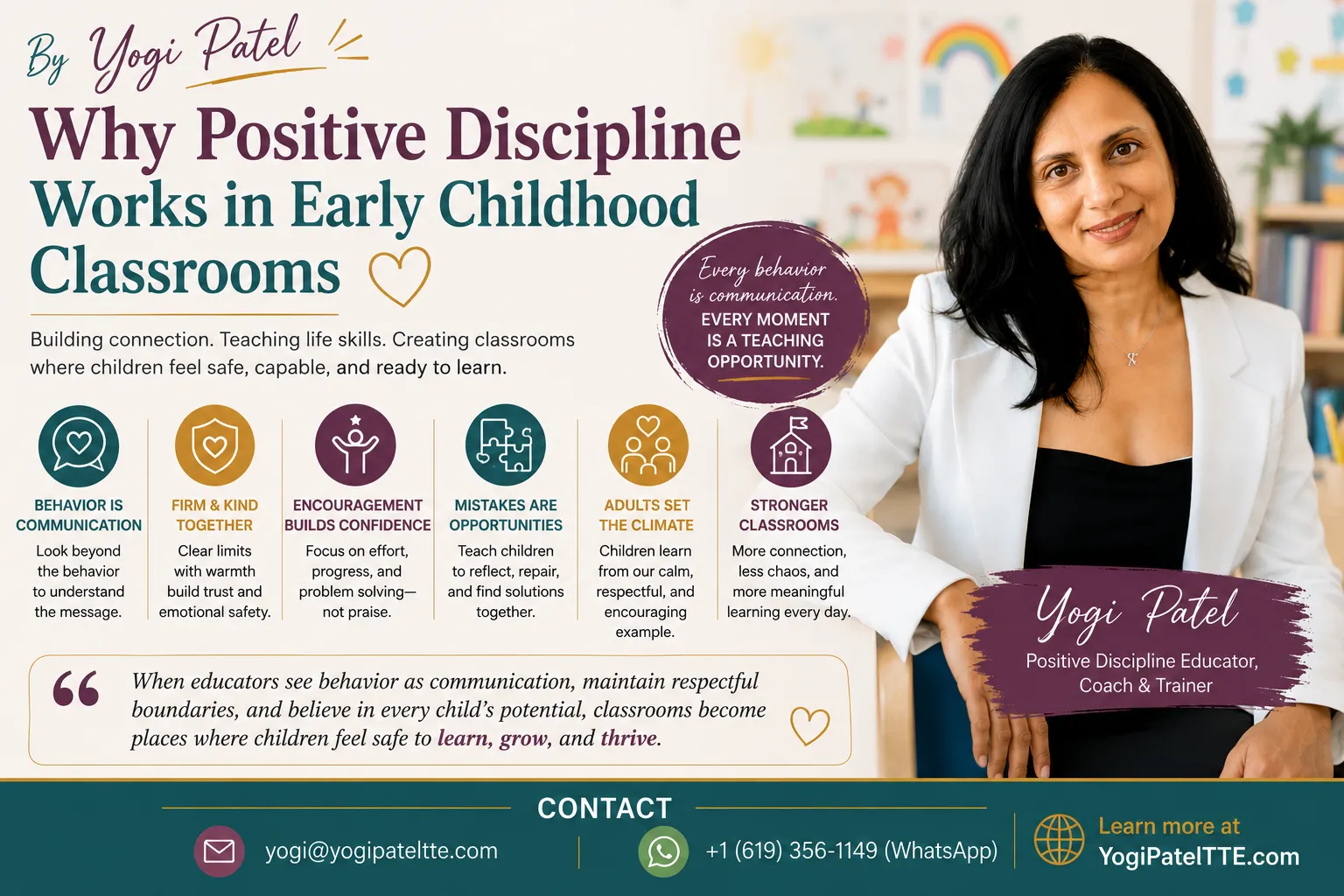
By Yogi Patel
Walk into almost any early childhood classroom and you’ll witness a wonderful mix of curiosity, joy, learning—and big emotions.
One child is upset because someone took the blue marker.
Another isn’t ready to leave the block area for circle time.
Two friends are arguing over whose turn it is.
A teacher is trying to comfort one child while helping another solve a problem.
If you’ve spent time with young children, you know this isn’t unusual. It’s part of a normal day in early childhood.
After more than 25 years of working with teachers, school leaders, and families around the world, I’ve learned that these moments are not interruptions to learning.
They are the learning.
The question isn’t, “How do I stop this behavior?”
The better question is, “What is this child trying to communicate?”
When we begin asking different questions, we begin finding different answers.
Behavior Is Communication
Young children don’t always have the words to express disappointment, frustration, fear, excitement, or even the desire to belong.
Instead, they communicate through their behavior.
A child who grabs a toy may not be trying to be unkind.
A child who refuses to clean up may be feeling overwhelmed by the transition.
A child who pushes another child may not yet have the language or skills to solve a problem differently.
When we see behavior as communication rather than defiance, our response naturally changes.
Instead of reacting, we become curious.
Curiosity opens the door to teaching.
Firm and Kind Can Exist Together
One of the biggest misconceptions about Positive Discipline is that it’s permissive.
It isn’t.
Children need clear expectations and consistent boundaries.
They also need to feel respected and emotionally safe.
Those two ideas belong together.
I might say,
“I won’t let you hit. I’ll stay with you while we figure out another way.”
The limit is clear.
The relationship remains intact.
Children learn that adults can be both caring and consistent.
That combination creates trust, and trust creates an environment where learning can flourish.
Encouragement Helps Children Discover Their Own Strengths
One of the shifts I encourage educators to make is moving from praise to encouragement.
Praise often focuses on the adult’s approval.
“Good job!”
“You’re so smart!”
Encouragement helps children notice their own effort and progress.
“You kept trying until you figured it out.”
“You found another way to solve the problem.”
“You worked hard even when it was challenging.”
Over time, children begin developing confidence from within rather than relying on someone else’s approval.
That confidence stays with them long after the activity is over.
Mistakes Are Opportunities to Learn
Every classroom is filled with mistakes.
Paint spills.
Towers fall.
Feelings get hurt.
Children interrupt.
These moments aren’t signs that learning has stopped.
They are opportunities to practice life skills.
Instead of asking,
“Who did it?”
we might ask,
“What happened?”
“How is everyone feeling?”
“What could we do differently next time?”
When children participate in solving problems, they develop responsibility, empathy, and confidence.
Those are skills that will serve them far beyond preschool.
The Adult Sets the Emotional Climate
One of the greatest lessons Positive Discipline has taught me is that children learn as much from who we are as they do from what we teach.
They notice how we respond when something goes wrong.
They watch how we speak to one another.
They observe whether we solve problems respectfully.
They learn from our example every single day.
As educators, we cannot expect children to develop emotional regulation if we aren’t practicing it ourselves.
Classroom culture always begins with the adults.
What I See When Teachers Embrace Positive Discipline
When schools begin consistently using Positive Discipline, I often notice meaningful changes.
Teachers spend less time putting out fires and more time building relationships.
Children begin solving small disagreements with increasing confidence.
Classrooms become calmer, not because children suddenly stop making mistakes, but because mistakes become opportunities for learning instead of punishment.
Perhaps my favorite observation comes from teachers themselves.
Many tell me they remember why they chose this profession in the first place.
Instead of spending the day managing behavior, they spend it developing capable, compassionate young people.
That is the kind of classroom every child deserves.
A Final Thought
Early childhood is about much more than preparing children for kindergarten.
It is where they begin developing confidence, cooperation, empathy, resilience, and a sense of belonging.
These qualities cannot be taught through rewards and punishment alone.
They grow through relationships built on encouragement, respect, and trust.
When educators see behavior as communication, maintain clear and respectful boundaries, and believe in every child’s ability to learn and contribute, classrooms become places where children feel safe enough to take risks, solve problems, and grow.
That is the heart of Positive Discipline.
If you’re interested in bringing Positive Discipline into your classroom or school community, I invite you to explore the resources, workshops, certification programs, and podcasts available here at YogiPatelTTE.com. My hope is to support educators in creating classrooms where children and the adults who teach them, can truly thrive.